
What Happens to Donated USB Drives That Don’t Make the Cut
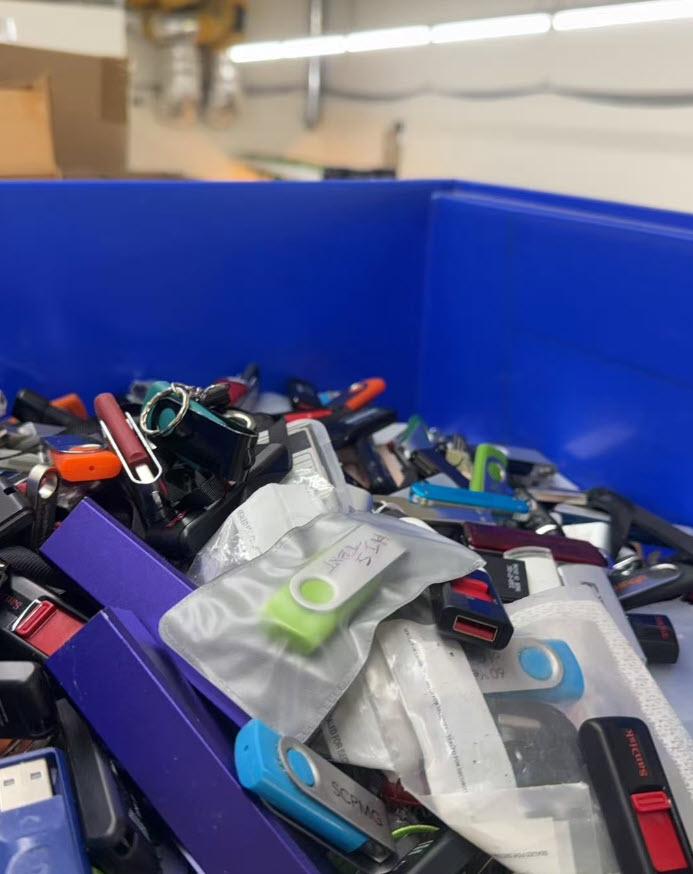
Not every USB flash drive that arrives at RecycleUSB.com ends up in a classroom. While many donated drives can be securely erased, reformatted, and repurposed for educational use, a portion simply can’t be reused. Rather than gloss over that reality, we think it’s important to explain what happens to those drives and why transparency matters.
Donated USB drives arrive in all conditions. Some are lightly used and still function perfectly. Others have lived a long life in keychains, desk drawers, pockets, and backpacks. When we process drives, we do so in batches every couple of months rather than on a strict monthly schedule. Each drive is tested before it’s ever considered for reuse.
On average, about thirty percent of the donated drives fail this process. These failures can happen for many reasons: controllers that no longer initialize, memory that can’t be reliably accessed, physical damage, or drives that simply won’t enumerate when connected. This isn’t unusual with older or heavily used flash media, and it’s an expected part of working with donated electronics.
When a drive fails testing, it’s set aside and never reused. These non-working units are collected separately and stored until they’re removed as electronic waste. RecycleUSB does not attempt to dismantle or reclaim materials from failed drives. Instead, they are placed into our designated e-waste stream.
Electronic waste removal is handled by our regular waste service provider, Waste Management. They collect the accumulated e-waste as part of scheduled service and handle disposal through their established electronic recycling processes. While we don’t control or audit the downstream recycling steps, we rely on a licensed waste management provider to handle disposal responsibly.
The key point is this: reuse always comes first. Any drive that can be safely erased and made reliable again is repurposed and sent on for educational use. Only the drives that genuinely cannot function are removed from circulation. Even with an unavoidable failure rate, reuse significantly reduces the number of devices that would otherwise head straight to disposal.
We share this process so donors understand exactly how their contributions are handled. There’s no expectation that every drive will be reused, but every drive is handled with care, attention to data security, and respect for the larger goal of reducing electronic waste while supporting learning.
As always, we’re grateful to everyone who sends in their unused USB flash drives. Whether a drive finds a second life in education or is responsibly retired, each donation supports a more thoughtful approach to technology reuse.
- Magilley Family – Charlottesville VA
- Stacy Dobbie – Menands NY
- LJ – Iowa
- Marissa Pedroza – Sierra Madre CA
- Highline Math Program – Los Alamos NM
- Tod Critchlow – Encinitas CA
- Tesha Hoping Ward – Winchester VA
- Suresh Pitt – Blue Bell PA
- Elgee Rehfeld – Juneau AK
- Marc Santillo – Westminster CO
- Schnor – Framingham MA
- Cassandra Blanco – Deltona FL
- Ganesh Sivalemar – New York NY
- Townsen Legal – Towson MD
- Alexander Bogdashevsky – Collegeville PA
- David DePiero – Edgewater NJ
Tags: data erasure, electronic waste, flash drive reuse, sustainability, USB recycling

